
- Out-of-Stock
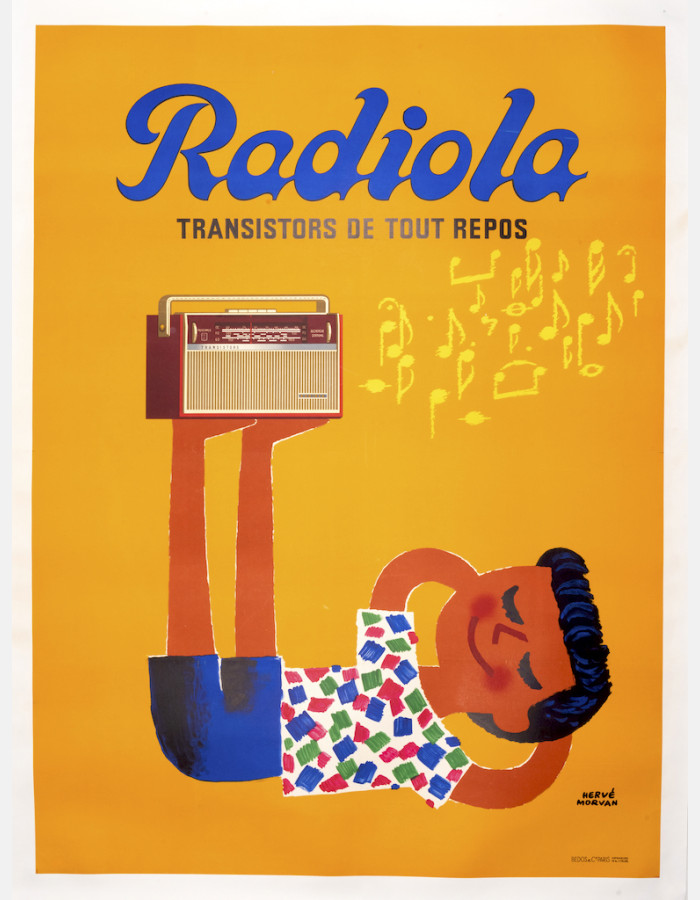
Sold
Transistors for complete peace of mind.
Anne-Claude Lelieur and Raymond Bachollet. Hervé Morvan poster artist. Paris Cultural Agency 1997. Page 278. Ill. 368.

Bernard Villemot came up with the idea of showing the arm and baton of a conductor conducting a radio to suggest high sound quality. The hand stands out against a dark background, giving this excellent image a solemn feel.
The RADIOLA brand has always maintained high standards in its advertising campaigns; in addition to Bernard Villemot, René Ravo was frequently called upon.

Ducretet-Thomson, the successor to the Ducretet company (a French pioneer in radio dating back to the late 19th century, which was acquired by Thomson in the 1930s), was then a major player in the consumer audio appliance market in France.
Guy Georget (1911–1997), one of the leading figures in postwar French advertising (also known for his famous Air France campaigns), created this poster around 1970.
Stylized buildings shaped like pointed houses, in bold colors, fan out on either side of the radio like the two panels of a theater curtain, and then a hand—created using a black-and-white photomontage, a technique popular at the time—reaches toward them, holding out the radio to bring music into every home.

Philips advertising poster for the Novosonic radio series, dated 1959,
This poster embodies the “French touch” of the late 1950s: the Novosonic line represents a revival of radio design at Philips, featuring a combination of two-tone casings (ivory and burgundy), a dashboard-style dial, and curved lines inspired by the automotive aesthetics of the time. The inclusion of both radios and record players at the bottom of the ad illustrates the diversification of Philips’ “audio” offerings during this period, when the radio ceased to be a mere utilitarian piece of furniture and became a stylish statement in its own right in the living room.
And already, the evening gown for a night out dancing.

Advertisement for Ducretet-Thomson radios, designed by Guy Georget, 1950s.
In the 1950s, the radio was the king of the home. Before television found its way into every living room, families gathered around the radio to listen to the news, soap operas, game shows, and music. New stations like Europe No. 1, launched in 1955, shook up the status quo with a freer and more modern tone. The radio, with its dial displaying the names of distant cities, was then a source of pride that people chose carefully, and manufacturers competed with one another through posters to attract buyers.

A large, beautiful poster from 1960 featuring bright, fresh colors.
The term “Stéréosonic” refers to the major innovation of the late 1950s: stereophony. The first stereo LP records were released in 1958, and manufacturers competed to offer devices capable of playing them, promising a “three-dimensional” listening experience.
At the same time, the transistor revolutionized radio listening: radios became lightweight and portable.

1957 poster by Alain Gauthier (1931-2020), one of the most inventive poster artists of the generation that followed Savignac and Villemot. In the 1950s and 1960s he worked for major brands and airlines: Air France, TAI, Royal Air Maroc, Danone, Bally and above all Teppaz, for which he created a highly acclaimed series of posters. His style combines naive drawing, gentle humor and bold colors.
From the 1970s onward, he devoted himself increasingly to painting and children’s book illustration, developing a poetic, dreamlike world (Alice, masks, mirrors, birds, forests) that earned him international recognition, from Japan to the United States.
The town of Boulogne-Billancourt, where he lived, held an exhibition of his work in 2016.

He created several hundred posters for clients such as Philips, BNP, Danone, Kuwait Airways, and Bally shoes, becoming an internationally recognized poster artist who received numerous awards from various juries. He later turned to editorial illustration, working for publications such as Elle, Télérama, Le Point, and The New York Times.
The slogan “They are one…” takes the union of the two cameras literally, embodied by a young married couple clinging to one another.
The characters, with their round faces, rosy cheeks, and naive features, contrast with the almost photographic rendering of the cameras, which remain the true heroes of the image.


This small poster is one of Hervé Morvan’s (1917–1980) most famous works: created in 1960 for Gitanes cigarettes, it earned him the 1961 Martini Medal the following year—the highest professional honor in French advertising poster design at the time.
Poster historians consider it a work of great aesthetic power, praised for its formal inventiveness: the bullfighter (or flamenco dancer) is dressed in a ruffled shirt and puffed sleeves made entirely of stacked Gitanes cigarettes, whose immaculate whiteness literally outlines the character’s costume.
The Gitanes brand will always retain this reference to the world of the “Gitans”—doesn’t this bullfighter have a curious hat?
Well done, Morvan—olé!

For nearly thirty years, Hervé Morvan (1917–1980) designed the posters for the annual campaign of Jeunesse au plein air (JPA), the confederation of secular organizations providing vacation programs for children and teenagers. Each year, schoolchildren sold stamps and stickers, the proceeds of which funded summer camps and vacation centers, enabling children from low-income families to go to the beach, the mountains, or the countryside. After the war, these group trips—organized by popular education movements and public schools—enabled millions of children to experience vacations at a time when few families could afford them.

For nearly thirty years, Hervé Morvan (1917–1980) designed the posters for the annual campaign of Jeunesse au plein air (JPA), the confederation of secular organizations providing vacation programs for children and teenagers. Each year, schoolchildren sold stamps and stickers, the proceeds of which funded summer camps and vacation centers, enabling children from low-income families to go to the beach, the mountains, or the countryside. After the war, these group trips—organized by popular education movements and public schools—enabled millions of children to experience vacations at a time when few families could afford them.

Morvan brings together the sea, summer, and the joy of vacation.
For nearly thirty years, Hervé Morvan (1917–1980) designed the posters for the annual campaign of Jeunesse au plein air (JPA), the confederation of secular organizations providing vacation programs for children and teenagers. Each year, schoolchildren sold stamps and stickers, the proceeds of which funded summer camps and vacation centers, enabling children from low-income families to go to the beach, the mountains, or the countryside. After the war, these group trips—organized by popular education movements and public schools—enabled millions of children to experience vacations at a time when few families could afford them.

This poster by Hervé Morvan, measuring 227 cm x 67 cm, was designed to be displayed on the sides of buses of that era; as a result, the artwork traveled through the streets, and graphic designers competed creatively to come up with a design concept that could fill this type of format without being boring. Here, Morvan brilliantly demonstrates his talent by highlighting the EVIAN brand without any characters, while piquing the curiosity of passersby and presenting the city with an elegant and humorous image.

Morvan brings together the sea, summer, and the joy of vacation.
For nearly thirty years, Hervé Morvan (1917–1980) designed the posters for the annual campaign of Jeunesse au plein air (JPA), the confederation of secular organizations providing vacation programs for children and teenagers. Each year, schoolchildren sold stamps and stickers, the proceeds of which funded summer camps and vacation centers, enabling children from low-income families to go to the beach, the mountains, or the countryside. After the war, these group trips—organized by popular education movements and public schools—enabled millions of children to experience vacations at a time when few families could afford them.