
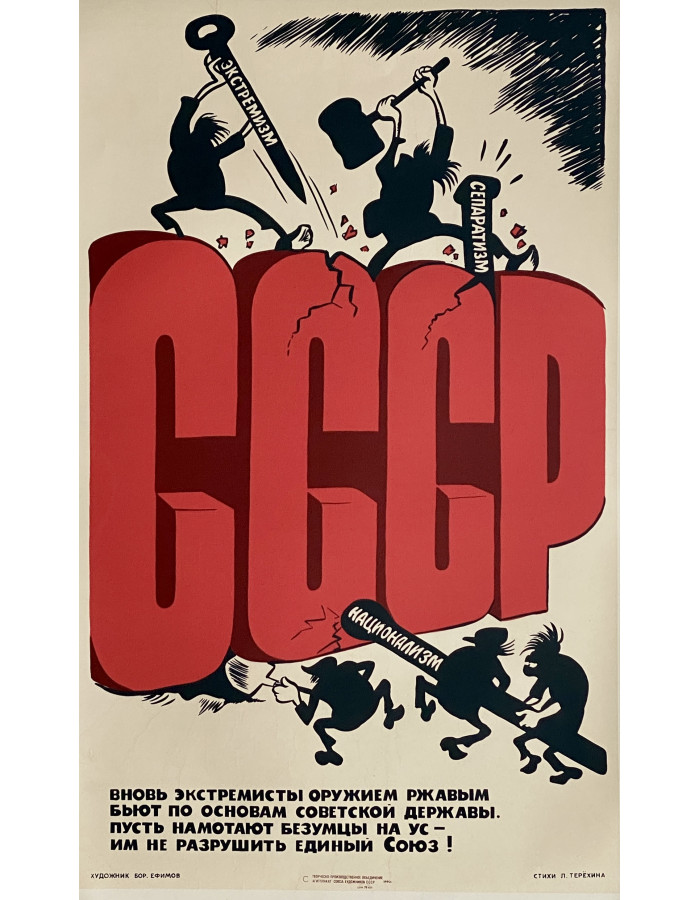
USSR – “They Will Not Destroy the Union!”.
Boris Efimov, poem by L. Terekhina, Agitplakat / Union of Artists of the USSR, 1990.
Tiny figures armed with “extremism,” “separatism,” and “nationalism” attack the giant letters spelling out “USSR”: one of the last Soviet propaganda posters, at a time when the Union was truly beginning to crumble.
Boris Efimov (1900–2008) was the greatest Soviet political cartoonist and one of the most extraordinary witnesses of the 20th century; he died at the age of 108.
Born in Kyiv, he published his first drawings as early as the 1920s and contributed for decades to Pravda, Izvestia, and the famous satirical newspaper Krokodil.
During World War II, his caricatures of Hitler and Nazi dignitaries brought him fame, and he covered the Nuremberg trials as a cartoonist. His energetic style, black silhouettes, and biting humor remain recognizable even in this poster, which he created at the age of 90.
In 1990, perestroika and glasnost, launched by Mikhail Gorbachev, brought freedom of speech to the fifteen Soviet republics. Nationalist movements flared up: Lithuania declared its independence in March 1990, soon followed by the other Baltic states, while the Caucasus erupted over Nagorno-Karabakh. The central government then produced a series of posters denouncing “extremists” and “separatists” and defending the unity of the Union. The final quatrain asserts that these fools will not succeed in destroying the Union, but history would prove them wrong: a year and a half later, in December 1991, the USSR ceased to exist. Published by Agitplakat, the Union of Artists’ studio responsible for political posters, this piece bears witness to the final flickers of Soviet propaganda.
This poster has been linen-backed in our own workshop with the utmost care, following museum-standard conservation criteria.
Our expertise, built on a constant interest in discovering new pieces, our status as an expert accredited by the CEFA, and our experience alongside auctioneers — having conducted over 50 auctions exclusively dedicated to posters — guarantee accurate description, authenticity, and long-term durability for your purchases.
Carole Ajam, Annette Melot-Henry and Jean-Robert Raviot. USSR: End of the Party. The Perestroika Years. Fage Editions 2011. Page 109.

This poster plays on a Russian pun: the title “Дым, в котором мы живём” (The Smoke We Live In) is a play on the well-known phrase “Дом, в котором мы живём” (The House We Live In)—the title of a popular 1957 Soviet film, among others—by replacing ‘Дом’ (house) with “Дым” (smoke), a simple letter swap that completely reverses the meaning.
The building depicted is literally constructed from cigarettes and cigarette butts, ironically illustrating the ubiquity of smoking in everyday Soviet life.
This type of public health poster from the late 1980s (the Perestroika era), which was more daring than previous ones, was part of the anti-smoking campaigns carried out in the USSR at that time.

The poster is signed “Khoudojnik K. Ivanov” (artist K. Ivanov).
It was published in 1990 by the Agitplakat Creative and Production Association, affiliated with the Union of Artists of the USSR.
Its composition is remarkably effective: the leg of a ballerina on pointe—a white silhouette against a black background—wears, in place of a tutu, a crown of yellow ration coupons—“heels” for sugar, meat, soap, tea, butter, and laundry detergent.
In the late 1980s, the Soviet Union’s deep economic crisis led to widespread shortages of basic necessities. The authorities then reintroduced a ration ticket system in many cities.
Amid the climate of perestroika and glasnost launched by Mikhail Gorbachev, the poster—long a tool of propaganda—became a vehicle for social criticism and satire.

A Soviet poster from the perestroika period, featuring a slogan deliberately printed upside down in mirror writing, along with its English translation: “Party—Mind, Honor, and Conscience of Our Epoch!”
The slogan echoes a phrase used by Lenin in 1917: “the intelligence, honor, and conscience of our era.” One of the catchphrases of Soviet propaganda
A portrait of Leonid Brezhnev (1906–1982), his chest covered with decorations; his eighteen years at the helm of the country are remembered as a period of “stagnation.”
Reversing the text completely changes the meaning of the poster: the official slogan, read backward, becomes a symbol of a world turned upside down, where the values proclaimed by the party have been overturned by the reality of corruption, the cult of personality, and stagnation.

The image shows Mikhail Gorbachev (1931–2022) with his baton raised, conducting from a score marked “V. I. Lenin,” beneath the exclamation “Bravo!” The return to “Leninist roots” was then a recurring theme in his rhetoric, in which he presented perestroika as a return to the authentic spirit of the revolution following the excesses of the Brezhnev era.
Signed “Fadina, A. Fadin ’88,” 25,000 copies were printed in 1990, one year before the dissolution of the Soviet Union.
The poster plays on ambiguity: is it a tribute to the leader orchestrating the reforms, or an ironic commentary on a leader who continues to play the same ideological tune? This double meaning is characteristic of “perestroika” posters from the late 1980s.

Soviet poster “In the developed capitalist countries, more than 16 million unemployed” — Moscow, late 1970s.
The poster was published in Moscow by “Plakat,” the leading publisher of political posters in the USSR beginning in the mid-1970s. The composition clearly illustrates the evolution of Soviet posters during the Brezhnev era. It moves away from heroic socialist realism to adopt a more modern graphic style, inspired by satirical cartoons and international graphic design
The signs in English, German, and Italian clearly identify the targeted countries: the United States, West Germany, and Italy.
Soviet propaganda seized upon this theme to contrast the crises of capitalism with the job security guaranteed by socialism.