
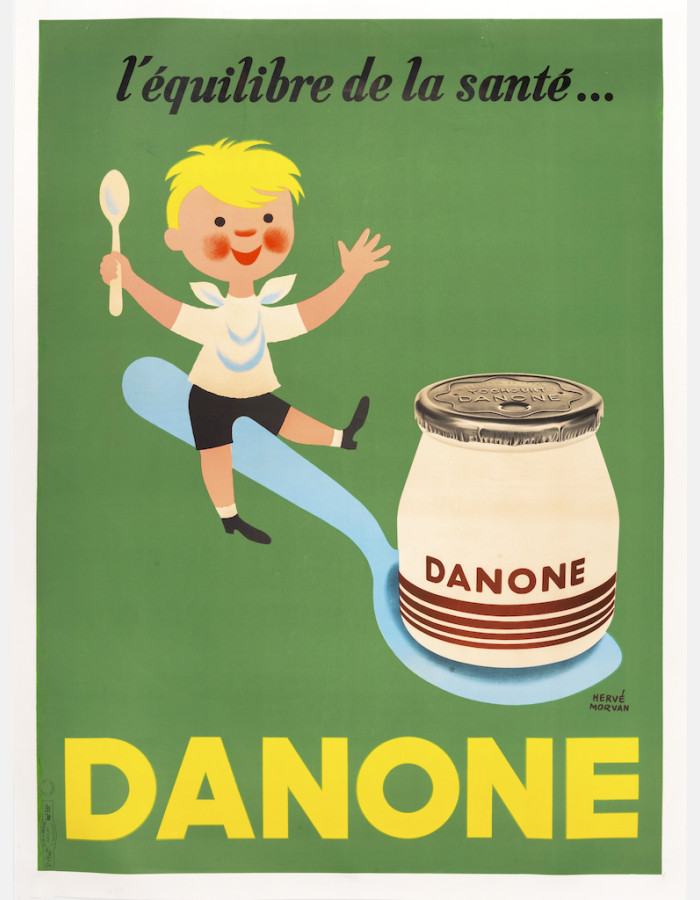
A poster by Hervé Morvan (1917–1980), a French poster artist and advertising designer trained at the École Duperré—one half of the fabulous trio, along with Bernard Villemot and Raymond Savignac, who were never at a loss for ideas in the postwar era.
The Danone brand traces its origins to 1919 in Barcelona, where Isaac Carasso, a Greek immigrant settled in Catalonia, developed a yogurt intended to combat digestive disorders in children.
In 1929, Daniel Carasso opened the first Parisian retail location in Montmartre, marking the beginning of the brand’s expansion into France, which would go on to become one of the world’s leading food and beverage groups in the decades that followed.
“Danone,” the Catalan diminutive of Daniel, his son’s first name... (Is that him on the spoon?).

On this 1958 small poster, the little girl—drawn like a doll by its creator, Alain Gauthier (1931–2020)—opens her shutters and discovers sunshine and yogurt cups, starting her day with joy.

This small poster, created by photographer Bianchini, features an image in the style of photojournalism, in the spirit of French humanist photography.
The candid shot, captured on the spot, replaces a staged studio setting, and the blue toning gives the entire piece a strong sense of unity. The poster was printed by Draeger, one of France’s most prestigious printing houses.
Starting in 1927, his photography studio was run by François Kollar, and he worked for clients such as Chanel, Lanvin, and Balenciaga. This expertise in photogravure explains the image’s exceptionally fine detail.


This small poster is one of Hervé Morvan’s (1917–1980) most famous works: created in 1960 for Gitanes cigarettes, it earned him the 1961 Martini Medal the following year—the highest professional honor in French advertising poster design at the time.
Poster historians consider it a work of great aesthetic power, praised for its formal inventiveness: the bullfighter (or flamenco dancer) is dressed in a ruffled shirt and puffed sleeves made entirely of stacked Gitanes cigarettes, whose immaculate whiteness literally outlines the character’s costume.
The Gitanes brand will always retain this reference to the world of the “Gitans”—doesn’t this bullfighter have a curious hat?
Well done, Morvan—olé!

For nearly thirty years, Hervé Morvan (1917–1980) designed the posters for the annual campaign of Jeunesse au plein air (JPA), the confederation of secular organizations providing vacation programs for children and teenagers. Each year, schoolchildren sold stamps and stickers, the proceeds of which funded summer camps and vacation centers, enabling children from low-income families to go to the beach, the mountains, or the countryside. After the war, these group trips—organized by popular education movements and public schools—enabled millions of children to experience vacations at a time when few families could afford them.

For nearly thirty years, Hervé Morvan (1917–1980) designed the posters for the annual campaign of Jeunesse au plein air (JPA), the confederation of secular organizations providing vacation programs for children and teenagers. Each year, schoolchildren sold stamps and stickers, the proceeds of which funded summer camps and vacation centers, enabling children from low-income families to go to the beach, the mountains, or the countryside. After the war, these group trips—organized by popular education movements and public schools—enabled millions of children to experience vacations at a time when few families could afford them.

Morvan brings together the sea, summer, and the joy of vacation.
For nearly thirty years, Hervé Morvan (1917–1980) designed the posters for the annual campaign of Jeunesse au plein air (JPA), the confederation of secular organizations providing vacation programs for children and teenagers. Each year, schoolchildren sold stamps and stickers, the proceeds of which funded summer camps and vacation centers, enabling children from low-income families to go to the beach, the mountains, or the countryside. After the war, these group trips—organized by popular education movements and public schools—enabled millions of children to experience vacations at a time when few families could afford them.

This poster by Hervé Morvan, measuring 227 cm x 67 cm, was designed to be displayed on the sides of buses of that era; as a result, the artwork traveled through the streets, and graphic designers competed creatively to come up with a design concept that could fill this type of format without being boring. Here, Morvan brilliantly demonstrates his talent by highlighting the EVIAN brand without any characters, while piquing the curiosity of passersby and presenting the city with an elegant and humorous image.

Morvan brings together the sea, summer, and the joy of vacation.
For nearly thirty years, Hervé Morvan (1917–1980) designed the posters for the annual campaign of Jeunesse au plein air (JPA), the confederation of secular organizations providing vacation programs for children and teenagers. Each year, schoolchildren sold stamps and stickers, the proceeds of which funded summer camps and vacation centers, enabling children from low-income families to go to the beach, the mountains, or the countryside. After the war, these group trips—organized by popular education movements and public schools—enabled millions of children to experience vacations at a time when few families could afford them.