
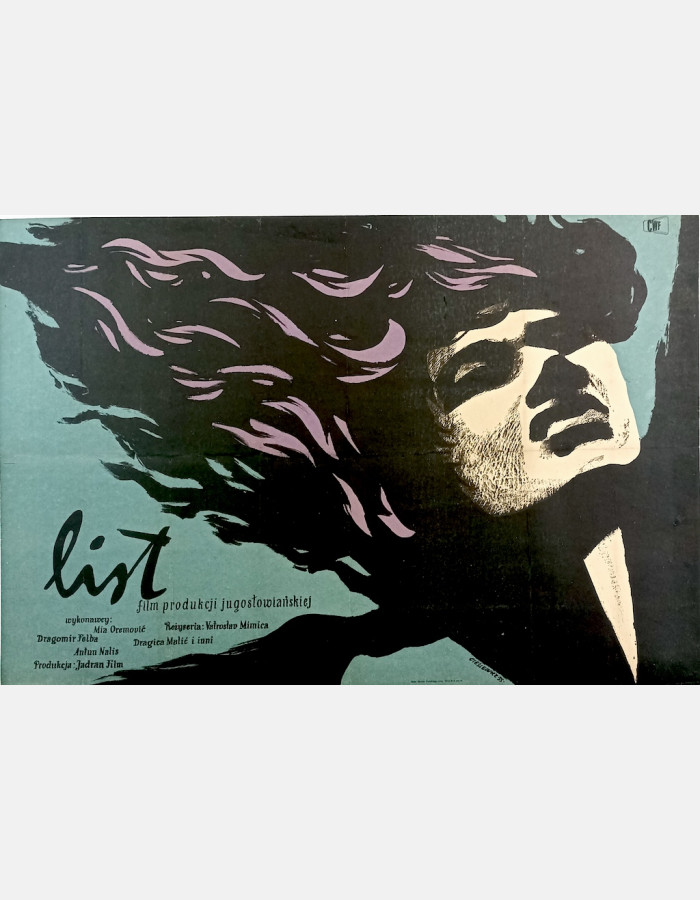
Poster by Roman Cieślewicz (1930–1996). The poster promotes the film “List” (The Letter) in Poland, a Yugoslav production directed by Vatroslav Mimica, starring Mia Oremović and Antun Nalis, and produced by Jadran Film.
There is no photo related to the film, but rather an image that is above all evocative of the graphic designer’s emotional response: here, a distraught face with hair ablaze in violet flames, intended to convey the dramatic intensity rather than the narrative content—an approach characteristic of the Polish school when dealing with foreign film productions.
This poster has been linen-backed in our own workshop with the utmost care, following museum-standard conservation criteria.
Our expertise, built on a constant interest in discovering new pieces, our status as an expert accredited by the CEFA, and our experience alongside auctioneers — having conducted over 50 auctions exclusively dedicated to posters — guarantee accurate description, authenticity, and long-term durability for your purchases.

5th International Print Exhibition, Moderna galerija, Ljubljana, 1963.
The Ljubljana International Print Biennial, founded in 1955, turned Slovenia (then part of Yugoslavia) into an unexpected meeting point between East and West at the height of the Cold War—one of the few places where Soviet, Western, and non-aligned artists exhibited side by side.
Three circles stacked vertically like lunar phases. The white one on top, the speckled gray one in the center, the beige/wood-toned one at the bottom—each “overlaps” the one below it. It’s a typically modernist interplay of that era, reflecting East-West influences.
This poster is bilingual (Slovenian/French), serving as a reference for an event that sought to establish itself as a fully-fledged international event.

For this 1977 poster, Cieslewicz takes as his starting point a photographic portrait from the turn of the century—a prominent figure in a dark suit and wing collar, an exemplary figure of the old order. In place of the face, he superimposes a second face, cut out from another photograph, printed in magenta and turned sideways. The character becomes a masked man, whose identity splits and eludes us. The technique alone conveys the play’s theme: behind the facade of respectability lies a sick, out-of-place, almost grimacing face. The contrast between the faded gray of the archival photograph and the artificial brilliance of the magenta lends the image its intensity.
The poster announces The Last Ones by Maxim Gorky, directed by Pierre Peyrou.

Roman Cieslewicz (1930–1996) was one of the leading figures of the Polish School of Poster Art. He made a name for himself in Warsaw in the 1950s with movie and theater posters. In 1963, he moved to Paris, where he became art director of Elle, then worked for Vogue and Opus International.
For this 1977 poster, Cieslewicz takes the title literally. “The Last Ones” are already dead: a crowd of skulls, lined up like spectators in the stands or on coffins, advances toward us.
The mechanical repetition of the motif creates a haunting effect that transforms this group into a funeral procession. The only touch of color—the magenta of the eye sockets—gives the skulls a vivid, hallucinatory gaze.

Che Si. Roman Cieslewicz, 1967, published in 1968 by Georges Fall for the magazine Opus International.
Cieslewicz takes Alberto Korda’s famous photographic portrait of Che and transforms it into a Pop Art icon with saturated colors, overlaid with a play on words: “Che? Sì,” Che, yes.
Roman Cieslewicz (1930–1996) was one of the leading figures of the Polish school of poster art. Trained at the Academy of Fine Arts in Krakow, he made a name for himself in Warsaw as early as the 1950s with his film and theater posters, which were characterized by photomontage. After moving to Paris in 1963, he became art director of Elle magazine, then of the MAFIA agency, and in 1967 helped launch the magazine Opus International, for which he designed the visual identity. He also founded the magazine Kamikaze.

Modern Polish Painting: Sources and Research – Musée Galliera, Paris, 1969, Roman Cieślewicz.
Roman Cieślewicz (1930–1996), a graduate of the Academy of Fine Arts in Kraków, was one of the leading figures of the Polish School of Poster Art. Having settled in Paris in 1963, he became art director of *Vogue* and later of *Elle*, establishing himself as one of the great graphic designers of his generation, a master of photomontage and the striking image.
For this exhibition dedicated to the art of his native country, he chose an image of extreme simplicity: a small white sphere in the center of a large red field—red and white being the colors of the Polish flag.
The poster thus encapsulates national identity and artistic modernity in a single symbol.

This Polish poster for Samuel Beckett’s *Radosne dni* (*Happy Days*, *Oh, Those Beautiful Days*), staged at the Teatr Mały, the small stage of the National Theater in Warsaw, was designed by Cieślewicz.
Roman Cieślewicz (1930–1996) was one of the greatest graphic designers of the 20th century, a leading figure of the Polish School of Poster Art, and a master of photomontage and halftone. Trained at the Academy of Fine Arts in Kraków, he moved to France in 1963, where he became art director of *Vogue* and *Elle* and taught at the École supérieure d’arts graphiques in Paris.
Samuel Beckett ( 1906 – 1989), who had been living in France since 1937 and wrote in both English and French, revolutionized theater with *Waiting for Godot* (1953). He was awarded the Nobel Prize in Literature in 1969.

A stunning poster by Roman Cieślewicz (1930–1996), one of the greatest graphic designers of the 20th century, co-founder of the Polish School of Poster Art, and a master of photomontage and typography.
Trained at the Academy of Fine Arts in Kraków from 1949 to 1955, he moved to France in 1963, where he pursued an international career. There, he became art director of *Vogue* and *Elle*, taught at the École supérieure d’arts graphiques in Paris, and created series of photomontages and collages such as *Monstres*, *Kamikaze*, *Zodiaque*.
He nevertheless remained connected to the Polish arts scene. In particular, he collaborated with the National Theater under the direction of Kazimierz Dejmek and later Adam Hanuszkiewicz, alongside Jan Lenica, Waldemar Świerzy, and Maciej Urbaniec.

The poster is signed and dated “R. Cieślewicz 68” (1930–1996); he was one of the leading figures in 20th-century graphic design. Born in Lwów and trained at the Academy of Fine Arts in Kraków, he established himself in the 1950s as one of the most inventive representatives of the Polish School of Poster Art.
In 1963, he moved to Paris, where he became art director of ELLE magazine, then of VOGUE, and in 1968 helped found the MAFIA agency. He obtained French citizenship in 1971.
The poster was printed by the Serg printing house in Paris and published by Georges Fall, publisher of the contemporary art magazine OPUS INTERNATIONAL, as part of his “Opus Poster” series of artists’ posters (No. 6).

Created by Roman Cieślewicz (1930–1996), a leading figure of the Polish school based in Paris, known for his photomontages and his radical, socially engaged visual language.
This image was created in 1968 for the cover of the Parisian art magazine Opus International, published by Georges Fall and printed by Serg in Paris. It depicts two nearly identical figures modeled after the archetype of the American comic book superhero, distinguished solely by the inscriptions “USA” and “CCCP” on their torsos—a striking visual commentary on the duality of the Cold War, suggesting that the two rival superpowers, despite their overt ideological opposition, actually share a desire for power.